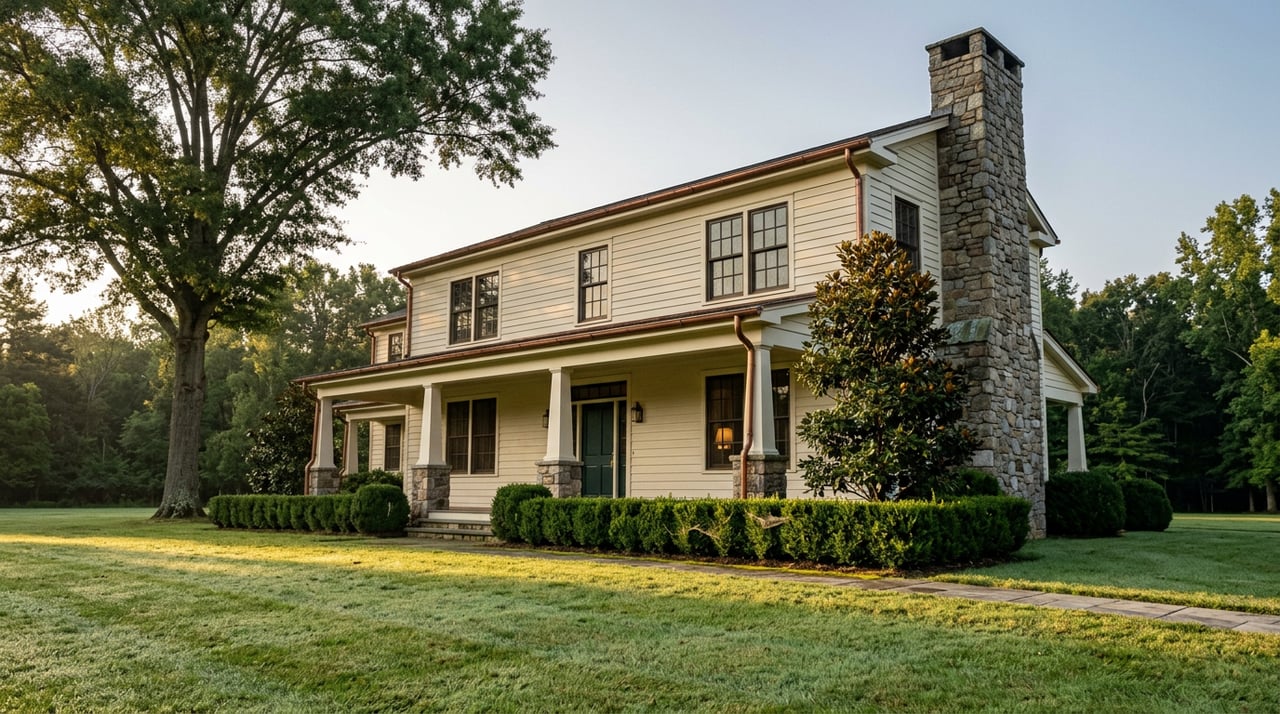
Milton Counted Its Horse Farms and Found Twice What It Expected
September 3, 2026
September 3, 2026
Drive Birmingham Highway on an ordinary Tuesday morning and you will pass a barn before you pass a stop sign. A few hundred yards later, past a cul-de-sac entrance with a stacked-stone monument sign, there is another one, set back behind a line of oaks, easy to miss if you are checking a text at the light. Most residents assume these properties cluster somewhere specific, a horse district you either live in or drive around. Milton's own Equestrian Committee assumed the same thing, and they were the ones counting.
The committee spent about a year on the project, wrapping up in early 2024, cross-referencing public records, driving every road in the city, and checking satellite imagery parcel by parcel. Chair Tony Rich has said the group expected the tally to land around 100 farms. The final count came back at more than 200, roughly double what the people running the project thought they would find. That gap between guess and reality is the whole story. Milton is not a city with a horse neighborhood. It is a city where horse properties are threaded through nearly every neighborhood, and almost nobody who lives here, including the committee that studies it, had the full picture until they went and looked.
The census produced more than a number. It produced a map, built from half-mile radius circles drawn around every farm the committee could confirm. Lay that map over the city and the pattern that emerges is dispersion, not concentration. Farms show up near Crabapple. They show up off Hopewell Road. They show up in pockets most residents would not flag as equestrian at all, tucked behind subdivisions built in the 2000s that never advertised a connection to the rural character next door.
That matters for how the city actually functions day to day. A resident who has never owned a horse and has no reason to visit a barn is still, statistically, living within a half mile of one. The occasional loose horse on a side street, the trailer backed into a driveway on a weekday afternoon, the smell of hay through an open car window on Freemanville Road, these are not curiosities confined to one part of town. They are ambient, spread across the map the way the committee's own research revealed, and they explain a texture of daily life here that a simple "estate lots available" description never quite captures.
Vice chair Carson Saville has pointed out a more practical reason the census exists beyond curiosity. It gives Milton Fire-Rescue actual contact information for farm owners in the event of a fire or an escaped animal, and it gives the city a working baseline instead of a guess. A guess of 100 farms and a confirmed count of 200-plus are not the same planning problem, and the committee only found that out by doing the legwork nobody had done before.
Milton considers any parcel of three acres or more a large lot for planning purposes, and that threshold sits at the center of a policy fight that has been working its way through City Hall since 2024. The economics are straightforward even if the politics are not. A three-acre horse property generates one home's worth of tax revenue and development activity. Subdivided into smaller lots under conventional zoning, that same three acres can generate several. Left alone, the incentives run toward subdivision, not preservation, which is exactly why the census landed when it did.
Throughout 2025, the Equestrian Committee worked with city staff to shape a package of large lot incentives designed to tilt that math back toward keeping land intact, and presented its recommendations to City Council that October. The proposal is not subsidy, it is friction removal, aimed at owners who might otherwise sell to a developer simply because holding onto acreage got harder than it needed to be. The specific asks on the table:
None of that reads as dramatic on its own. Together, it is the difference between a horse property owner renewing a commitment to keep the land as it is and one who decides the paperwork burden has finally outweighed the lifestyle. The city also recently extended a pause on approving new small-lot subdivisions inside its agricultural zoning district while it reworks the minimum standards for those lots, a sign that the pressure to split larger parcels is not hypothetical.
Read against the census, the incentive package looks less like routine zoning housekeeping and more like an attempt to hold a line the city just discovered it had. You cannot protect a number you have not measured. Milton spent a year measuring it, and the incentive debate now underway is the direct result.
Residents who value the rural feel of these corridors have a genuine stake in how that debate resolves, whether or not they own so much as a saddle.
None of this would matter as much if the equestrian identity here were purely regulatory. It is not. The Equestrian Committee runs a recurring "Ask the Equestrian" feature on the city's social channels, the kind of thing that once broke down how dressage and show jumping actually work heading into the Paris Olympics, aimed squarely at neighbors who have never sat a horse but live down the road from one. The city also runs an informal barn spotlight, inviting owners to submit photos and a bit of history for a chance to be featured, treating the structures themselves as part of the civic identity worth documenting.
Some of the individual stories carry more weight than a policy brief ever could. The city's public materials also show how equestrian spaces can serve neighbors beyond the owners themselves. At the farm belonging to committee chair Tony Rich, the vocational program Lionheart WORKS holds weekly sessions involving farm work, from filling water buckets and laying out hay to spending time around the animals, a small partnership that turns one private horse farm into something closer to shared infrastructure.
The city's biggest public expression of all this is Meet the Neighbors, an annual open house organized with the Equestrian Committee on the pasture-like greenspace at the corner of Freemanville and Birmingham roads. Vendors are screened to keep the event genuinely equestrian, horse-related goods and services only, and residents who show up spend a couple of hours doing exactly what the name promises, meeting horses and the people who keep them. It is the one afternoon a year when the dispersed, half-invisible network the census mapped becomes visible all at once, in one field, instead of scattered across two hundred separate driveways.
Birmingham Park's trails carry a version of that same connective role the rest of the year, functioning as some of the most used riding trails in the city and giving the equestrian community a shared public space that does not require an invitation to a private farm.
Taken together, the census, the incentive fight, and the small human stories add up to a single point worth holding onto. Milton's horse country was never a neighborhood you could point to on a map. It was already everywhere, hiding in plain sight behind ordinary subdivision fences, until the people responsible for understanding this city finally went out and counted it.
If you are weighing what a corridor like Birmingham Highway, Freemanville, or Hopewell actually means for a property you own or one you are considering, Catherine Newsome works this part of North Fulton closely enough to talk through the zoning and lifestyle questions that a listing sheet will never answer. Request your free home valuation and let's talk about what your stretch of Milton is really part of.
This article is general information, not legal, tax or financial advice. Consult a qualified professional about your situation.
November 19, 2026
November 12, 2026
November 5, 2026
October 29, 2026
October 22, 2026
October 15, 2026
October 8, 2026
October 1, 2026
September 24, 2026
Whether you're buying or selling, Catherine Newsome is committed to guiding you through every step of the real estate process with integrity, passion, and personalized service. Let her help you find your dream home or sell your property for the best price—your goals are her priority!